


Freelancing rewards speed, consistency, and sharp judgment more than ever. In 2026, generative AI has dramatically compressed the time needed to produce high-quality work, creating a genuine opportunity for disciplined beginners who know how to combine powerful tools with strategic thinking. The real advantage belongs to those who treat AI as a highly capable collaborator — not a replacement for client insight, taste, and quality control.
This guide cuts through the hype to deliver a practical, sustainable path from zero experience to paid clients. It focuses on execution details most tutorials overlook and highlights the positioning that turns scattered gigs into reliable income.
Finding Your Entry Point in a Crowded Market
Success begins with selecting services where AI delivers clear leverage without turning your offer into a commodity. The strongest opportunities lie in areas that blend AI efficiency with essential human oversight: content strategy and writing, social media asset creation, email automation sequences, basic chatbot setups, and targeted research summaries.
These services are in steady demand from small business owners, coaches, consultants, and SaaS teams who need consistent output but don’t have the time or in-house resources. Many freelancers, particularly in regions like India, are building stable income by offering monthly LinkedIn content systems — complete with carousels, captions, and strategic posting schedules — for coaches looking to grow their personal brands.
Specificity is critical. A generic “AI content writer” profile gets lost among thousands. In contrast, offering “LinkedIn content systems for executive coaches using AI acceleration” immediately stands out and supports higher starting rates.
What most people get wrong
Too many beginners chase every trending service or deliver raw AI output with minimal refinement. Clients quickly recognize generic work, leading to revisions, low ratings, or lost trust. The sustainable edge comes from using AI for speed and volume while applying human judgment on strategy, brand alignment, tone, and relevance.
Building an Efficient, Low-Cost Tool Stack
Keep your early tool stack lean and focused. Core tools include Claude (currently favored for longer, more nuanced writing), ChatGPT or Gemini for research and iteration, Canva’s Magic Studio for visuals and short videos, and Notion AI for client project organization and templating.
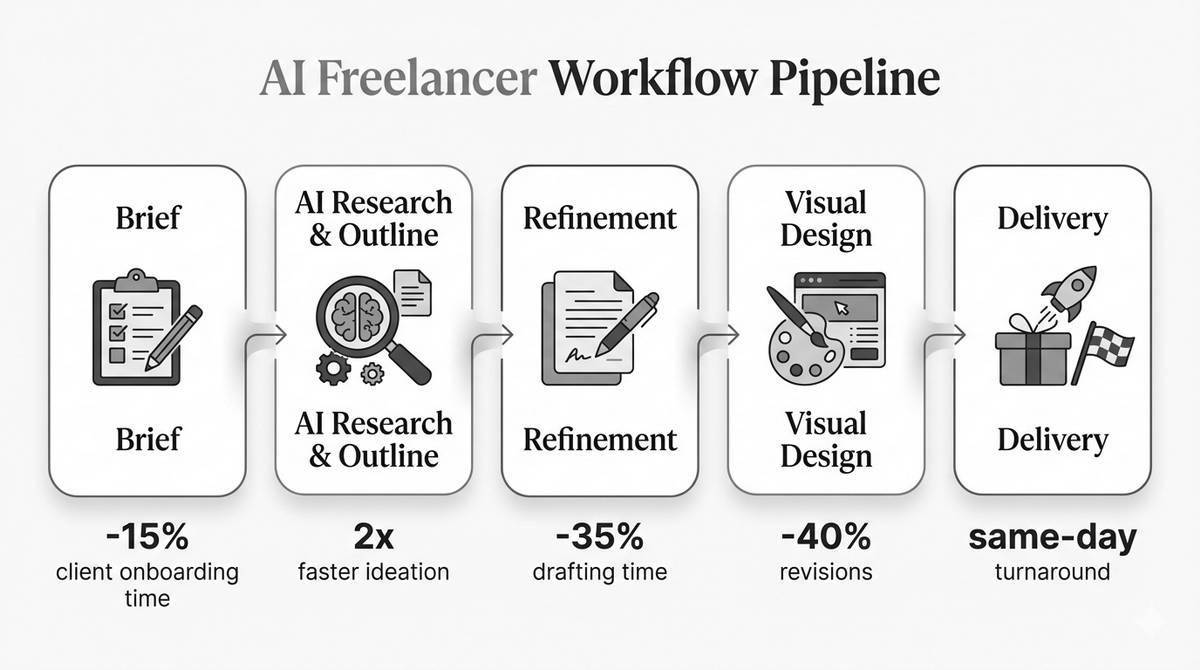
As cash flow improves, you can add specialized tools like Surfer SEO for content optimization or ElevenLabs for voice work. The biggest productivity gains, however, come from building repeatable workflows rather than collecting more apps. A well-designed content process might flow from client brief to AI outline, fact verification, human refinement, visual enhancement, and final review — significantly reducing delivery time while producing noticeably better results than pure AI competitors.
Establishing a Strong Presence on Freelance Platforms
Choose your platforms wisely. Upwork generally supports higher lifetime client value and retainers, while Fiverr works well for testing productized packages quickly. In both cases, focus your profile and proposals on client outcomes rather than tools or tasks.
Strong profiles emphasize results — helping coaches increase engagement or consultants fill their sales pipelines. Proposals perform best when they reference the client’s specific situation and demonstrate clear understanding of their goals. Use AI to draft efficiently, but always invest time in meaningful customization.
Most beginners start at modest rates ($15–35 per hour or $100–300 per project) to build momentum and reviews. With consistent delivery and strong feedback, many dedicated freelancers reach $1,000–3,000 monthly within 4–8 months. Rate increases become natural once you have 8–15 positive deliveries.
Refining AI Output Into Client-Ready Work
The quality of your prompts determines everything. Vague inputs produce average results. Effective prompts include clear role definition, audience details, tone examples, brand constraints, and success criteria. The best freelancers treat AI conversations as iterative collaboration — generating options, critiquing them, and layering in original insights or client-specific context.
Practical example: When drafting sales emails, AI can generate dozens of variants rapidly, but the freelancer’s real value lies in selecting the strongest elements, incorporating authentic client stories, testing subject lines, and ensuring perfect brand alignment. This hybrid approach consistently outperforms both fully manual work and unedited AI output.
Developing Systems That Support Growth
Once you secure two or three regular clients, shift focus from daily hustle to building systems. Develop reusable templates for onboarding, content briefs, and deliverables. Automate repetitive admin tasks using tools like Zapier. These improvements free up mental energy for higher-value client work and relationship building.
Consider your income models carefully. Monthly retainers offer stability, project-based work brings variety, and productized packages scale more predictably. Top performers often position themselves as systems builders — delivering not just content, but repeatable processes clients can partially manage themselves.
Strategic insight Generalists remain vulnerable to price competition and market shifts. Specialists who develop deep knowledge in one industry or platform (such as LinkedIn for coaches) build authority faster, attract inbound leads, and command premium rates. This focus also makes it easier to create your own digital products later.
Realistic Limitations and Warnings
AI tools still have important limitations. They can hallucinate facts, miss very recent developments, and struggle with highly nuanced strategic work. Over-reliance risks client detection and reputation damage. Platform algorithm changes and broader economic conditions can also impact visibility.
A realistic warning The tools that lower the barrier to entry are also intensifying competition and pressuring rates in execution-heavy categories. Freelancers who treat AI as a crutch rather than a multiplier often plateau quickly or burn out. Long-term success depends on continuously developing irreplaceable human skills: client communication, strategic thinking, and creative judgment.
Track your effective hourly rate and time per deliverable. Steady efficiency improvements through better prompts, templates, and selective automation create a powerful compounding advantage.
Positioning for Sustainable Income
Build beyond freelance platforms by creating a simple personal website that showcases real case studies and process insights. Share thoughtful observations on LinkedIn or X about AI-augmented workflows. These efforts help generate inbound leads and position you as a knowledgeable partner rather than just another service provider.
The freelancers thriving with AI in 2026 combine machine speed with genuine human judgment and relationship skills. They avoid competing solely on cost and instead focus on delivering measurable outcomes and systems that create real value for clients.
Learn more about AI Freelancing: How to Land Your First Client on Upwork or Fiverr, AEO for Freelancers: How to Show Up When Clients Ask AI for Recommendations & How to Use AI to Write Client Proposals and Contracts, 10 AI Tools Freelancers Are Using to Work Faster and Earn More & Best AI Tools for Career Growth and Skill Development