


If you’ve typed this question into a search bar, you probably don’t need a computer science lecture. You need to know what generative AI actually does, how it works in the real world, and — more importantly — whether it can help you build something, earn something, or claw back the four hours you’re wasting on tasks that should take twenty minutes.
That’s exactly what this article delivers. No jargon wall. No breathless hype. Just a clear breakdown of what generative AI is, which tools are worth your time depending on what you’re trying to do, and where the real income opportunities are — alongside some honest caveats most introductory articles conveniently leave out.
So, What Is Generative AI?
Generative AI refers to artificial intelligence systems that create new content — text, images, audio, video, code, or data — rather than simply analyzing or categorizing existing content.
The “generative” part is the key distinction. Traditional AI might look at a photo and tell you there’s a cat in it. Generative AI creates the photo of the cat from scratch, based on your description.
Under the hood, these systems are trained on massive datasets. They learn statistical patterns in language, images, or sound, and then use those patterns to produce new outputs that resemble — but aren’t copied from —what they’ve been trained on. The most well-known architecture powering many text-based tools is called a Large Language Model (LLM). ChatGPT, Claude, and Gemini all run on variations of this.
What makes the current wave different from earlier AI isn’t the concept — it’s the quality, accessibility, and versatility. These tools have crossed a threshold where outputs are genuinely useful without expert intervention.
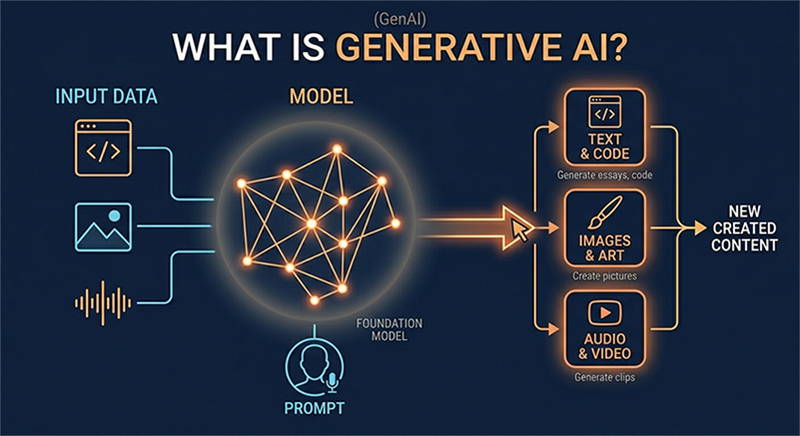
Categories of Generative AI Tools
1.Text Generation: LLMs
Tools: ChatGPT (OpenAI), Claude (Anthropic), Gemini (Google), Mistral
These tools generate written content, answer questions, summarize documents, write code, draft emails, create outlines, and hold extended back-and-forth conversations.
Best for: Writers, marketers, developers, customer support teams, researchers, consultants — essentially anyone who spends significant time producing written output or processing information.
Income model suggestions:
- Freelance writing with AI-assisted drafting (positioning yourself as an editor/strategist, not a typist)
- AI prompt engineering services for businesses building internal tools
- Content production at scale for SEO agencies or newsletters
- Building and selling custom GPTs or Claude Projects tailored to specific industries
The quality gap between these tools is narrowing, but Claude tends to handle nuanced reasoning and longer documents more reliably. ChatGPT has broader integrations. Gemini is tightly woven into Google Workspace, which matters if your clients live in Docs and Sheets.
2. Image Generation
Tools: Midjourney, DALL·E 3 (via ChatGPT), Stable Diffusion, Adobe Firefly
These tools produce original images from text prompts. The range runs from photorealistic renders to illustrated styles, logos, and abstract art.
Best for: Designers, marketers, content creators, ecommerce sellers, indie game developers, social media managers.
Income model suggestions:
- Print-on-demand products (t-shirts, wall art, mugs) using Midjourney-generated designs on platforms like Redbubble or Etsy
- Custom illustration packs sold on Creative Market or Gumroad
- Social media content creation services for small businesses
- Book cover design for indie authors (a surprisingly active market)
Midjourney produces the highest aesthetic quality for artistic work. Adobe Firefly is the safest choice for commercial use because it’s trained on licensed content, which matters if a client ever asks about IP. Stable Diffusion requires more setup but gives you full local control and no ongoing subscription.
3. Code Generation
Tools: GitHub Copilot, Cursor, Claude, ChatGPT
These tools write, explain, debug, and refactor code. Some integrate directly into your code editor; others work through chat interfaces.
Best for: Developers of all skill levels, non-technical founders building MVPs, automation specialists.
Income model suggestions:
- No-code/low-code development services for small businesses
- Building SaaS micro-tools and selling them (or their templates)
- Technical writing and documentation services
- Automating internal workflows for companies using tools like Make or Zapier, with AI generating the logic
Cursor and Copilot win on workflow integration. Claude handles complex reasoning tasks and longer codebases with more context. If you’re non-technical and learning to build, start with Claude or ChatGPT before investing in paid developer tools.
4. Audio and Video Generation
Tools: ElevenLabs (voice), Suno (music), Runway, Kling, Pika (video)
These are the fastest-evolving category. Voice cloning, AI music creation, and short video generation from text prompts are all now commercially accessible.
Best for: Podcasters, course creators, video marketers, musicians, agencies producing content at scale.
Income model suggestions:
- AI voiceover services for explainer videos, audiobooks, and ads
- Producing royalty-free music packs for content creators
- Short-form video content for brands using tools like Runway
- Dubbing or localization services for video content
This space moves fast. Tools that feel cutting-edge today will likely look modest in 12 months. Build income streams here, but don’t build an entire business identity around one specific tool’s current capabilities.
What Most People Get Wrong About Generative AI
The most common mistake isn’t technical — it’s positional.
People approach these tools as replacements for skill and then wonder why the outputs feel generic. Generative AI amplifies existing knowledge and judgment. If you understand your subject, your audience, and your craft, these tools dramatically accelerate your output. If you don’t, they produce confident-sounding mediocrity at scale.
A second common error: treating the first output as the final product. Professional AI use is iterative. You prompt, evaluate, refine, redirect. The people earning real income with these tools aren’t the ones who type one sentence and publish. They’re the ones who understand how to direct the model toward a specific outcome through structured prompting and domain knowledge.
Third: ignoring context limits and accuracy issues. LLMs can and do produce incorrect information, especially on niche topics, recent events, or anything requiring precise factual recall. They’re reasoning engines, not encyclopedias. Verification is non-negotiable for any high-stakes output.
Strategic Insight: The Real Opportunity Isn’t in the Tools Themselves
Here’s what most beginner-focused content glosses over: the tools are commodities. Access to ChatGPT or Midjourney doesn’t give you an edge because everyone has it.
The actual competitive advantage lies in knowing what to ask for and understanding the output well enough to improve it. That’s domain expertise applied through AI — and that combination is genuinely scarce.
A marketer who deeply understands conversion psychology will produce better AI-generated copy than someone who doesn’t, every single time. A developer with strong architecture instincts will build better AI-assisted tools than someone learning to code from scratch. The model is a multiplier, not a replacement.
This reframes how to think about learning. Rather than rushing to master every AI tool, focus on deepening one area of expertise and learning how to use AI within it. That’s a defensible position. “I know how to use ChatGPT” is not.
A Realistic Warning: Where Things Can Go Wrong
A few things worth saying directly:
Income claims in this space are frequently inflated. Stories of people making thousands per month selling AI art or AI-written content exist, but survivorship bias is real. Most people who try don’t achieve those results, and the markets that were lucrative in 2022 are often saturated or devalued now.
Quality floors are rising. Clients are increasingly sophisticated. They can tell when content is unedited AI output, and many are actively filtering it out. The bar for AI-assisted work is rising, not falling. That’s good news if you’re adding real value, and bad news if you’re banking on volume alone.
Intellectual property and licensing rules are still unsettled. Particularly in image generation, the legal landscape around training data and commercial use remains contested. Using tools like Adobe Firefly or Getty’s generative offering reduces risk. Selling outputs from tools with unclear licensing could expose you to future liability, depending on how court cases develop.
Over-reliance creates skill atrophy. If you use AI to write everything, handle all research, and generate all creative work without staying actively engaged, you may find your own baseline skills eroding. Use these tools to accelerate and scale your thinking — not to replace it.
Where to Start If You’re New to This
If you’re at the beginning and trying to figure out where to focus:
- Start with one text-based LLM (Claude or ChatGPT) and use it daily for a month on actual work tasks. Learn how it responds, where it fails, and how to steer it.
- Pick one use case rather than exploring everything. Content writing, coding assistance, image creation — choose the one most relevant to your existing work or income goal.
- Study prompt structure. How you frame a request matters more than which tool you use. This is a learnable skill with clear returns.
- Build something small.
- A simple workflow, a template pack, a single digital product. Execution — evenimperfect — teaches you more than any amount of reading about AI.
Generative AI is a real shift in how creative and knowledge work gets done. The people who treat it as a productivity layer on top of genuine skill will find it genuinely transformative. Those looking for a short cut around developing any skill will find it less durable than advertised.
The tools are accessible. What you bring to them still matters.
Take a look at The Complete Beginner’s Guide To Using AI Tools in 2026 & How to Build a Faceless Instagram Account with AI in 2026