


The difference between AI and machine learning isn’t just a terminology question. How you understand it shapes which tools you pick, how you describe your skills to clients, and whether the income model you’re building is actually sustainable.
These two terms get used interchangeably in articles, job listings, and pitch decks, which creates real confusion for anyone trying to build something practical with them. The confusion isn’t harmless. Freelancers overbid on projects outside their actual skill set. Course creators attract the wrong audience. Automation builders miscalibrate client expectations.
Getting the distinction right is a functional advantage.
What Artificial Intelligence Actually Covers
Artificial Intelligence describes any system designed to perform tasks that would normally require human-like reasoning: understanding language, making decisions, recognizing images, solving problems. The term has been around since the 1950s, and the definition has stretched considerably since then.
For most of its early history, AI was rule-based. Developers wrote explicit instructions: if this condition, then this action. The chess programs of the 1990s fit that model. Deep Blue could defeat a grandmaster, but it wasn’t learning from the game. It was executing a very large, very fast decision tree.
The shift came when researchers stopped writing every rule by hand and started building systems that could derive rules from data on their own. That shift gave rise to machine learning as a practical discipline, and it changed what AI could realistically do.
What Machine Learning Is, Specifically
Machine learning is a method within AI where systems improve by training on examples rather than following pre-coded instructions. The core idea: expose the system to enough data, and it will identify patterns that generalize to new situations.
Spam filters work this way. So does Spotify’s recommendation engine, Google Translate, and the fraud detection system your bank uses. None of these were programmed with a list of rules about what spam looks like or what music you’d enjoy. They inferred those patterns from millions of labeled examples.
Three training approaches are worth knowing by name, not for technical depth, but because they help explain why different tools have different failure modes:
Supervised learning trains on data that has already been labeled. An image classifier trained to detect defects on a factory floor learned by looking at thousands of images already tagged “defect” or “no defect.” The quality of the labels determines the quality of the output.
Unsupervised learning finds structure in data that has no labels. Customer segmentation tools typically use this approach, grouping users by behavior without being told in advance what the groups should look like.
Reinforcement learning trains through trial and feedback, rewarding the system when it makes good decisions. This is how game-playing AI improves, and it underlies much of the work going into robotics and autonomous systems.
Deep Learning and Generative AI: The Layers That Matter Now
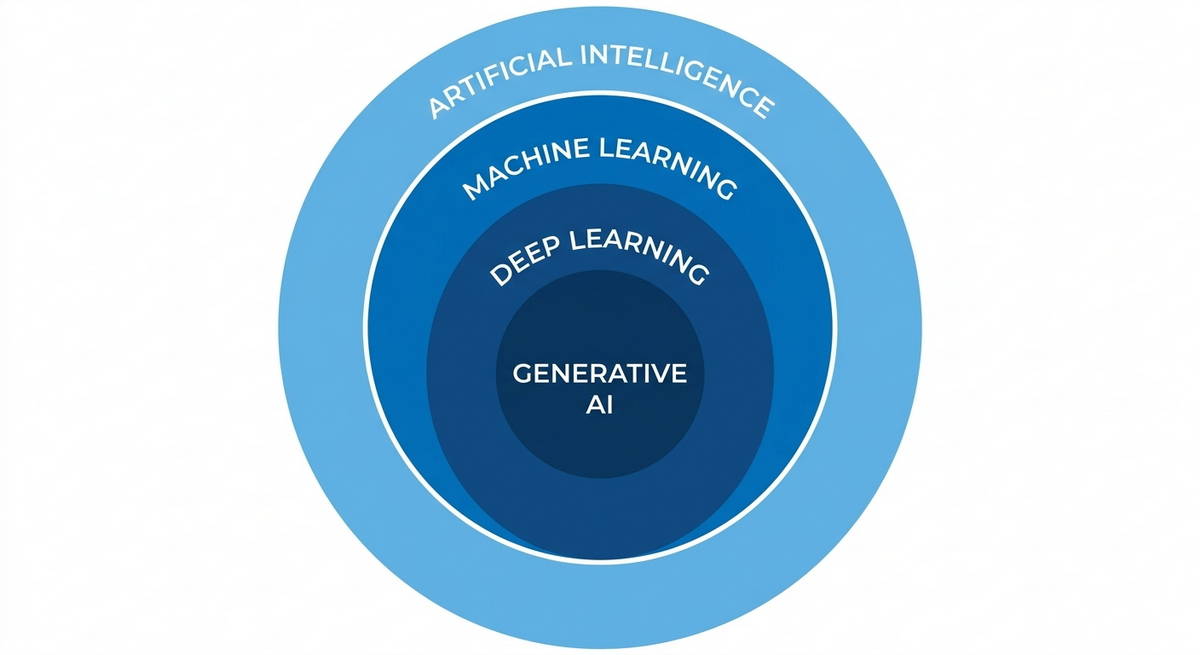
Within machine learning sits a more specific category called deep learning, which uses neural networks with many layers to process complex, high-dimensional data: images, audio, natural language. The depth of these networks is what allows them to handle nuance that simpler models cannot.
Generative AI sits within deep learning. The distinction is in what the system produces. Where earlier ML models classified or predicted, generative models create: text, images, audio, video, code. ChatGPT, Claude, Midjourney, and ElevenLabs all sit in this category.
The full hierarchy looks like this:
Artificial Intelligence → Machine Learning → Deep Learning → Generative AI
When someone in a freelance forum says they “use AI tools,” they almost certainly mean generative AI specifically. This matters because generative AI has a particular set of characteristics: it produces probabilistic outputs, it has knowledge cutoffs, it is sensitive to prompt construction, and it hallucinates. Those aren’t bugs unique to any one product; they’re properties of the underlying ML approach.
What Most People Get Wrong About This Distinction
The common mistake isn’t conflating the terms. It’s treating conceptual clarity as a substitute for applied knowledge.
Plenty of beginner guides explain the AI/ML hierarchy, then leave the reader with nothing actionable. Knowing that machine learning is a subset of AI does not tell you how to use a language model more effectively. What does help is understanding why these systems behave the way they do.
Large language models, for example, are trained to predict the most statistically probable next token given what came before. They are not retrieving facts. They are not reasoning in the way humans reason. It generate text that fits the pattern of the training data. This is why a tool like ChatGPT or Claude can produce a confident-sounding answer that is factually wrong: plausibility and accuracy are different optimization targets.
For anyone building a client service around AI-generated research, summaries, or reports, this is a practical constraint that needs to be designed around. A verification layer isn’t optional. Clients who receive incorrect output don’t blame the model; they blame the person who delivered it.
The same logic applies to image generation. Midjourney and similar tools use diffusion models, which reconstruct images from noise guided by a text prompt. They don’t interpret spatial instructions the way a human designer would. Prompting for specific compositional relationships (“the subject standing slightly behind and to the left of the door”) frequently fails, not because the tool is poorly made, but because that’s not how diffusion models process spatial language. Knowing this changes how you prompt and what you promise clients.
How the AI/ML Distinction Maps to Income and Positioning
The hierarchy isn’t abstract once you think about where you actually sit in it.
Freelancers using AI tools for content, design, or copywriting are working at the generative AI layer. Technical ML knowledge is irrelevant to this work. The skill that commands higher rates is prompt engineering precision, output QA, and the ability to build repeatable production workflows. Clients who pay well for this work are not paying for AI access (they have it). They’re paying for a process that reliably produces usable output.
Automation builders connecting platforms like Make, Zapier, or n8n to AI APIs occupy a different position. They’re not doing machine learning, but they’re building on top of it. The practical challenge here is that ML models are static after training. A customer service bot built on a frozen model won’t know about a product update from last month unless the system includes a retrieval mechanism that feeds it current information. This is why automation pipelines that actually hold up over time tend to include data refresh logic, not just a model call.
Builders developing AI-native products — niche SaaS tools, custom assistants, fine-tuned models for specific industries — need ML fundamentals more than either of the above. Decisions about whether to use a pre-trained base model, fine-tune on proprietary data, or build a retrieval-augmented system have direct cost and performance consequences. Getting it wrong doesn’t just affect quality; it affects margins.
Course creators and content entrepreneurs occupy their own lane. “Difference between AI and machine learning” and “how to use machine learning for business” are aimed at entirely different readers with different comfort levels and different buying behaviors. Precision in framing attracts a better-matched audience and reduces churn.
The Warning Worth Paying Attention To
A particular type of positioning has become common in the AI education space: learning just enough terminology to convey authority, then monetizing that appearance of expertise before developing real execution capability.
This works briefly. The people who plateau are the ones who stayed at the terminology layer. As AI tooling becomes more accessible and the baseline of what clients understand rises, the gap between “knows the concepts” and “can deliver results” is becoming more visible, not less. The consultants charging meaningful rates six months from now will be the ones who spent this period building output, not just explaining the stack.
This article gives you a conceptual foundation. What you do with it matters more than the foundation itself.
Strategic Insight: Two Career Tracks Are Forming, and They Don’t Overlap Much
The market is separating into two distinct groups, and the gap between them is widening.
ML practitioners — people with genuine technical depth in model training, evaluation, fine-tuning, and deployment — occupy roles that remain scarce and well-compensated. The barrier to entry is high, the supply is still limited, and the work is not easily replicated by non-technical generalists. This track rewards depth.
AI generalists, people applying generative AI tools with real precision inside a specific professional domain, are building a different kind of value. A marketing strategist who uses AI to produce rigorous competitive analysis is not an ML engineer, but they’re doing something a basic ChatGPT user is not. The differentiator is domain expertise combined with methodical use of the tooling. “I use AI for content” describes almost everyone. “I use AI to produce regulatory compliance documentation for fintech companies” describes almost no one.
For readers without a technical background, the second path is the more accessible one, and the market for it is real. The constraint isn’t AI knowledge. It’s the depth of domain expertise you bring to the AI layer.
Understanding where AI ends and machine learning begins is genuinely useful context. It clarifies what the tools you use are actually doing, where they break, and how to talk about your work accurately. But it’s context, not a product. The product is the work you build on top of it.
Quick Reference Summary
Artificial Intelligence is the parent field: systems that perform tasks requiring human-like reasoning.
Machine Learning is the dominant method: systems that improve by training on data rather than following explicit rules.
Deep Learning is a subset of ML using layered neural networks; it handles images, audio, and language at scale.
Generative AI sits within deep learning; it creates outputs (text, images, audio, video) rather than classifying or predicting.
For most freelancers, creators, and digital entrepreneurs, the tools in daily use live at the generative AI layer. Understanding the full stack doesn’t make you a better user, but understanding how generative AI works does: it is probabilistic, it has cutoffs, it optimizes for plausibility, and it requires human judgment to produce reliable output.
That’s the part most explainers skip.
Learn more about AI vs Automation: What’s the Difference?