

Type “best invoicing app for freelancers” into ChatGPT, Perplexity, or Google’s AI Overview right now. There’s a decent chance you won’t see a single blue link worth clicking. You’ll see an answer instead: three or four tool names, a line on what each does well, maybe a quick comparison. None of it resembles the search results page you’ve spent years trying to rank on.
Answer Engine Optimization describes exactly that shift, and it isn’t SEO wearing a trendier acronym.
What AEO Actually Is
Answer Engine Optimization is the practice of structuring content so generative AI systems can pull it directly into a generated answer. That list includes ChatGPT, Claude, Perplexity, Gemini, and Google’s AI Overviews. Traditional SEO chases a position on a results page. AEO chases something different: inclusion in the response itself, citing your brand or your name as the source.
The distinction matters because the two goals reward different behavior. Ranking first has always meant convincing an algorithm your page deserves the top slot. Then it means convincing a human to click through. Earning a citation in an AI answer means convincing a language model instead. The bar is different: your content needs to read as clear, accurate, and attributable enough to quote or summarize without double-checking elsewhere. Nobody clicks through to confirm it. The answer is the destination.
Roughly half of Google searches now surface an AI Overview above the traditional results. ChatGPT alone fields questions from hundreds of millions of people every week. Many of those questions used to start with a search box instead. That matters most directly for freelancers publishing client blog posts and solopreneurs running their own sites. The traffic shift isn’t something to plan around later; it’s already happening.
People also use the term “generative engine optimization,” or GEO, almost interchangeably with AEO. In practice the two overlap heavily. AEO tends to cover the full range of answer formats, including featured snippets and voice assistants. GEO usually refers more narrowly to optimizing for generative chat tools specifically. For a beginner, the distinction rarely changes what you actually do day to day. Treat them as close cousins rather than separate disciplines to learn.
Why AEO Works Differently Than SEO
A search results page gives users choices. An AI answer gives them a decision the model already made. If your content isn’t one of the two or three sources the model pulled from, you don’t rank sixth. You’re simply not there. A page can rank on page one of Google, and ChatGPT can still leave it out of its answer entirely. That’s because the model isn’t scanning for keyword density or backlink count. It’s scanning for a passage it can lift cleanly: an early, direct answer that reads as verifiable.
Persuasive copy works against you here. Traditional SEO writing often keeps someone scrolling on purpose: a long introduction, a slow build-up, a call to action near the bottom. Answer engines extract short, self-contained chunks of text instead. Answer engines rarely pull content that buries its point under three paragraphs of throat-clearing, no matter how well it reads.
The format has a real limit worth flagging upfront, too: it doesn’t suit everything you publish. A personal essay or an opinion piece that leans on narrative tension loses its purpose inside an answer-first structure. Treat this as the default for informational content, not a rule for every article on your site.
The Habit That Doesn’t Carry Over
Most of the AI-related content advice circulating right now treats AEO as SEO with different targets. That assumption is quietly costing writers and small businesses visibility. The tools and instincts that built SEO success don’t transfer automatically.
Someone who’s spent years optimizing in Ahrefs or Surfer SEO thinks in terms of keyword gaps and backlink profiles. Those tools are still useful for understanding what people search for. But neither one tells you whether ChatGPT or Perplexity is actually citing your page when someone asks a related question. Finding that out means asking the models directly. Run your target questions through Claude, ChatGPT, and Perplexity. Then note whether your brand, your name, or a competitor’s shows up in the response.
Frase and a handful of similar platforms have started adding AEO-specific scoring. It flags whether a page’s opening paragraph reads as a self-contained answer. For AI beginners building out a content stack, tools like this function differently than traditional SEO software. Think of them as general AI productivity tools worth adding alongside what you already use.
The most common mistake writers make with this kind of scoring is treating it as a pass or fail gate. A low score usually doesn’t mean starting over. It usually means the actual answer shows up a sentence or two later than it should.
The pattern shows up clearly in how people revise old content. An SEO-first edit means adding a keyword to a subheading or tightening a meta description. An AEO-first edit means rewriting the opening two sentences so they answer the reader’s actual question without any setup. Then it means checking whether Claude or ChatGPT picks up that passage when you ask the underlying question directly. The first kind of edit takes five minutes and rarely moves anything. The second takes longer, and it’s the one that actually changes whether the model cites you.
How Answer Engines Actually Choose What to Cite
Structure comes first. Answer engines favor pages that state a clear response early and support it with specifics afterward. A page that opens with a 40 to 60 word direct answer is far easier for a model to extract. Follow that with detail, examples, and edge cases, not a story or a broad framing paragraph. That’s a real adjustment for writers used to hooking readers with narrative openings.
Structured data still matters, but it doesn’t work alone. FAQ schema, Article schema, and Person schema (for author credibility) give AI systems labeled information instead of asking them to infer it from prose. Most WordPress-based sites can add FAQ blocks through the SEO plugin they already run.
What it won’t do is manufacture clarity that isn’t there. Plenty of sites add complete schema markup, and answer engines still skip over them. Usually, the content underneath the markup doesn’t resolve the question as directly as a competitor’s does.
Recency and consistency carry more weight than most writers expect. AirOps’ 2026 State of AI Search research found that for commercial and evaluation-stage queries, 83% of AI citations came from pages updated within the past 12 months, and more than 60% came from pages refreshed within the last six months. A page updated within the last few months tends to earn more trust than one that hasn’t changed in two years. A visible modified date reinforces that trust, even when the older content is technically still accurate. Consistency compounds this. A bio, a service list, or a pricing page that contradicts itself elsewhere on the site sends the wrong signal. It’s exactly the kind of inconsistency that makes a model hesitant to cite you as an authority..
One well-optimized page also rarely carries an entire topic on its own. Answer engines often need to resolve a follow-up question the original query implies. A site that only covers the surface-level version of a topic tends to lose out to a source that goes deeper. A cluster of related pages, each answering one specific question clearly, usually outperforms a single long page trying to cover everything at once.
Who This Actually Benefits
Independent creators and small operations have an advantage here that’s easy to miss. Large, established brands often carry years of inconsistent content, outdated pages, and messy site architecture that’s expensive to untangle. A freelancer or solopreneur starting from a handful of clean, well-structured pages has a real edge. They can outperform a competitor ten times their size simply by not carrying that baggage.
There’s also a business opportunity forming underneath this shift, worth naming directly for anyone thinking about making money with AI tools. More small businesses are realizing their SEO investment doesn’t automatically carry over to AI visibility. That’s creating demand for people who can restructure content, implement schema, and monitor citations across platforms.
Freelancers with a content or technical background can offer that service without needing enterprise software to start. A handful of AI freelance tools built around citation tracking now run well under $100 a month. That puts them within reach of an independent consultant testing the space before committing to it.
The trade-off is less about cost and more about voice. Getting good at AEO means writing more plainly, which can flatten the personality that makes a brand’s content recognizable. Optimizing purely for extraction makes a page read a little clinical. Most publications, including this one, end up finding a middle ground. Answer-first structure sits near the top of a piece, with room for voice and nuance once the piece answers the core question.
AEO doesn’t come with guarantees. A citation in an AI answer doesn’t always send a click back to your site. That makes traditional traffic metrics a poor way to judge whether it’s working. Citation frequency also fluctuates. ChatGPT might pull a page into its answers this month and drop it the next. These models update and re-weight sources on a schedule nobody outside the AI labs controls. The realistic framing is a long-term visibility layer that runs alongside SEO rather than one you can forecast on a quarterly timeline.
Where to Start This Week
AI beginners tend to overcomplicate the first step, treating AEO like a technical overhaul instead of a content adjustment. The realistic starting workflow is smaller than most guides suggest.
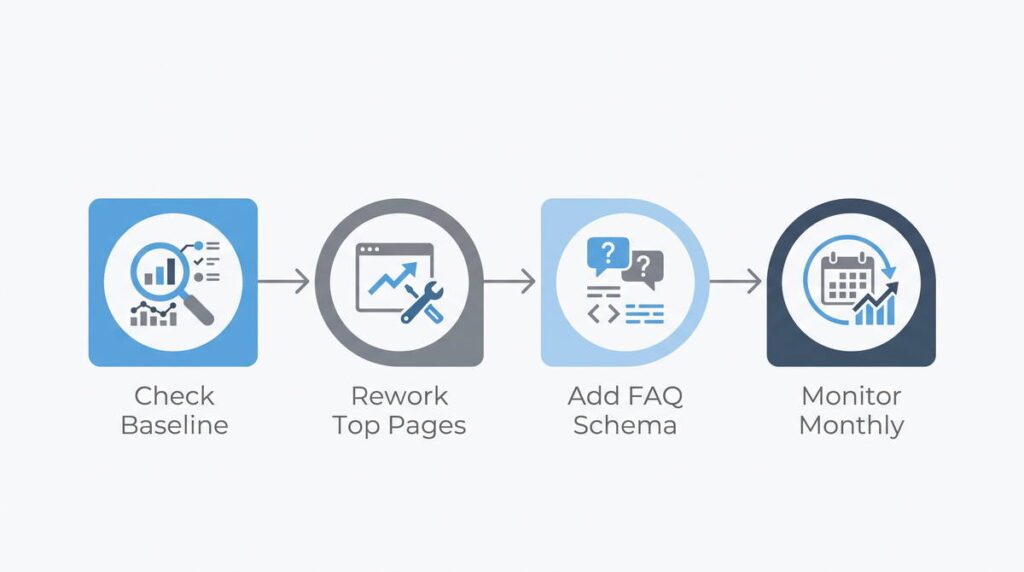
Start by establishing a baseline. Ask ChatGPT, Claude, and Perplexity the same three or four questions someone in your niche would actually type. Note whether you show up, whether a competitor does, and whether the citation is accurate. Twenty minutes of this tells you more than most paid audit tools will.
From there, pick your two or three highest-traffic pages. Rework the opening sentences into a direct, self-contained answer before touching anything else. Add FAQ schema to any page that already answers common questions; it’s the highest-leverage change for the least effort. Then build a light monitoring habit. Checking your baseline questions monthly is enough automation for most independent creators. Skip the dedicated tracking subscription until your traffic or client base justifies one.
None of this finishes in a weekend. And none of it works in isolation from the SEO fundamentals still driving most of your traffic. Build it in a page at a time. Expect the payoff to show up unevenly rather than all at once.
Also check How to Get Your Business Cited by ChatGPT and Google AI Overviews, AEO for Freelancers: How to Show Up When Clients Ask AI for Recommendations & How to Use AI + Notion for Task Management