
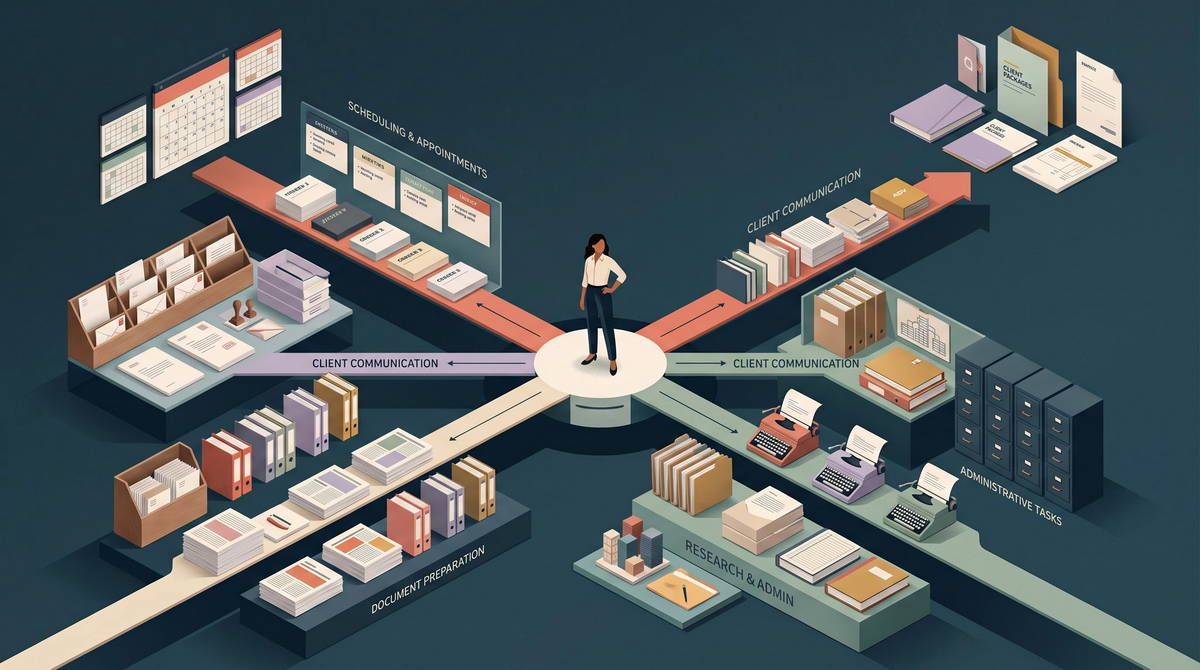

Inbox triage, calendar coordination, data entry: five years ago, this was most of what virtual assistant work meant. Clients paid for it hour by hour. Generative AI tools now handle most of this work in seconds. That’s breaking the old hourly pricing model that used to define this business.
What’s replacing it isn’t AI doing the same job faster. It’s a service that runs on judgment. That means knowing which client problems are worth automating. It means building a workflow that runs the same way every time. And it means stepping in when the output needs a human eye. Clients are starting to pay for that judgment specifically. That changes what the service looks like, and it changes how you price it.
An AI virtual assistant business doesn’t require an admin background or an existing client list to start. It requires knowing two or three tools well. It requires one service offer with a clear outcome. And it requires a pricing structure that doesn’t punish you for getting faster at the job. It’s also one of the more direct ways to make money with AI tools. You don’t need to build software, a course, or an audience first. Everything else is execution. Most of the actual difficulty lives there, not in the concept.
What “AI Virtual Assistant” Actually Means Now
The term covers two fairly different businesses, which is part of why pricing conversations get murky. One version is a freelancer using ChatGPT or Claude to draft emails and summarize documents. They move faster through tasks they’d otherwise do by hand. The other is someone building automated systems with Zapier or Make. These systems keep running with almost no client input at all.
A social media manager usually falls into the first camp. They draft captions with Claude, then edit and schedule them manually. An e-commerce operator handling order confirmations and shipping updates usually needs the second option. The workflow fires automatically off a database change. Nobody drafts anything in the moment.
Neither model is more legitimate than the other. They’re not interchangeable, though. Clients often don’t know which one they actually want when they say “I need help with AI.” Part of the job is figuring that out before quoting a price, not after.
Who This Model Actually Fits
People working in a structured role tend to pick this up fastest: admin coordination, project management, content operations, customer support. They already understand scope creep and client expectations, so the AI tools are additive rather than an entirely new discipline. Freelancers moving out of traditional VA work already skip the hardest part most service providers face. They know how to manage a client relationship.
On the buyer side, the clearest fit is solopreneurs and small business owners. They need extra capacity but can’t justify a full-time hire. Picture a coach running group programs, a small agency juggling several retainers, or a real estate agent managing listings. All three generate a steady stream of routine communication. Map that communication out, and it’s easy to systemize.
This model works less well as a passive income idea, whatever the marketing around it implies. Client acquisition, communication, and quality control don’t disappear because AI is doing the drafting. Beginners who expect the tools to handle outreach and retention, not just execution, tend to stall out within months. The tools rarely fail. Half the job was never about the tools in the first place.
Regulated industries are a harder starting point, too. Healthcare, legal, and financial services clients often need a compliance layer to review every AI-touched output. That review time can erase the efficiency gain the whole pitch relied on.
The Skill Most Beginners Skip
Most beginner guides lead with tool selection: which AI assistant to buy, which automation platform to learn first. That’s backwards. The common mistake is building fluency with software first. It happens before identifying the specific, recurring problem a client will actually pay to solve.
A calendar automation is worthless without the right client first. You need someone whose scheduling breaks down in a specific, describable way. The tool doesn’t create the demand. The diagnosis does.
The skill that holds up over time is workflow design. Take a vague client complaint, like “my inbox is a mess” or “I never have time to write updates.” Turn it into a defined, repeatable process. An AI tool can then execute that process the same way every time. That translation work is what you’re actually selling. The software underneath it changes every year. The diagnostic skill mostly doesn’t.
There’s a real complication for anyone starting this today, though. The platforms clients already use are quietly absorbing a lot of that baseline work. Gmail and Outlook draft replies natively now. Notion and Calendly have their own built-in AI features. That doesn’t eliminate the opportunity. But it does shrink the market for anyone whose entire pitch is “I’ll use AI to answer your emails.” The more durable positioning sits a layer above that. It means connecting tools across a client’s existing stack. It means maintaining the workflow when something breaks. And it means applying judgment the built-in features don’t have.
The Tools Worth Learning First
Most workable setups run on a narrow stack of AI freelance tools:
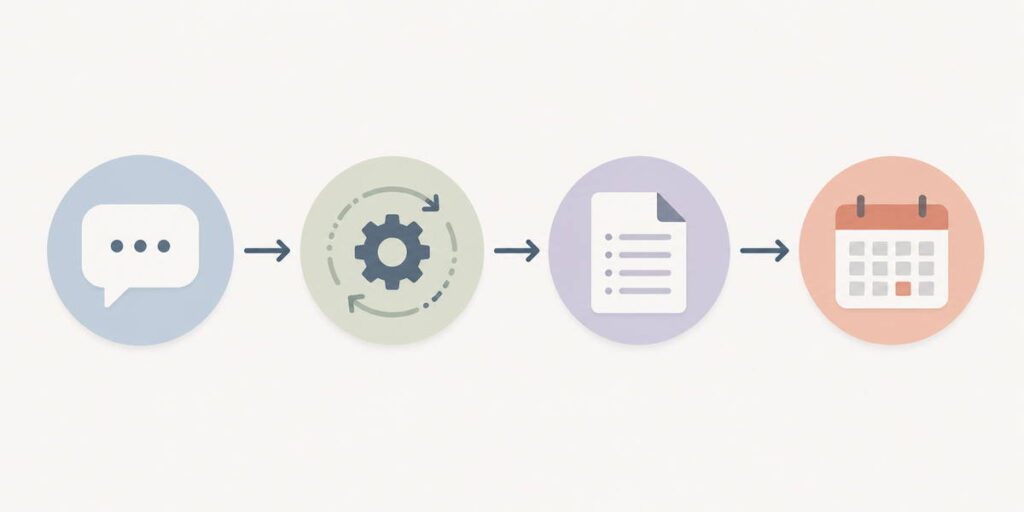
- ChatGPT or Claude for drafting, summarizing, and research support
- Zapier or Make for connecting apps and automating handoffs between them
- Notion AI or ClickUp for project organization and client documentation
- Calendly, often paired with an AI scheduling layer, for meeting coordination
- Otter.ai or Fireflies for transcription and action-item extraction from calls
Stick to two or three tools centered on one service. That’s usually enough to start. A common early mistake runs the other direction: collecting a wide tool stack before the first workflow even works reliably. That just creates more failure points than value. Add tools as specific client problems demand them, not in anticipation of problems that haven’t shown up yet.
Structuring Services Clients Will Actually Pay For
Clients rarely pay well for “AI help” as an abstract category. They pay for an outcome you deliver on schedule. A freelance copywriter, for example, might use AI for outlining and first-pass research. They keep the final edit and voice entirely manual. Then they sell that as a content service, not an “AI writing” service. The framing matters more than the tool stack behind it.
A few service structures tend to package well:
- Inbox and calendar management, using AI to draft responses and flag conflicts before the client even sees them
- Content repurposing, turning one long-form piece into social posts, email copy, and short summaries
- Meeting operations, transcribing calls and distributing action items automatically
- Recurring research or competitor reporting on a set schedule
- Light automation builds and maintenance: the Zapier or Make workflows a small business needs but has no time to build
Selling two or three of these together as a single monthly retainer tends to hold up better. Pricing each task on its own rarely does. It gives the client a reason to keep paying month over month. They’re not re-evaluating the relationship every time a task list runs dry.
Why Hourly Pricing Undersells What You’re Actually Selling
Hourly billing made sense when the work was manual. It stops making sense once AI compresses execution time, because it directly punishes getting better at the job. A task that used to take three hours might now take forty minutes. That doesn’t mean you should price it at forty minutes of value. The outcome and the reliability behind it haven’t changed at all.
Retainer or package pricing solves this by tying cost to the outcome instead of the clock. Price a monthly retainer for inbox and calendar management around what the client actually gains: several reclaimed hours a week. Don’t price it around how long the AI-assisted process takes behind the scenes.
A Rough Pricing Range
Rates vary by market, niche, and experience, so treat these as reference points rather than a formula. General AI-assisted admin support tends to land between $20 and $45 an hour equivalent for beginner-to-intermediate positioning. Workflow automation and specialized reporting work often runs $60 to $120 an hour equivalent or more. That gap isn’t random. The freelance market right now rewards specialists who can build and maintain automations. It pays noticeably less to people who are simply fast with a chat tool. That spread looks more likely to widen than close, as more generalists show up on the low end.
Raising Rates as Proof Accumulates
Starting price isn’t the risky part. Staying there is. The common failure mode looks less like picking the wrong number and more like this: price low to land the first few clients, take on more of them to make the math work, and end up with a full calendar and no time left to find better-paying ones. Underpricing doesn’t build a business. It builds a schedule that can’t grow.
The fix isn’t a bigger jump upfront. It’s a scheduled one. Once a workflow has run long enough to produce a specific, quantifiable result, a cleared inbox backlog, a turnaround time cut in half, a fixed number of hours reclaimed every week, that result becomes the basis for the next rate. Not “I’ve gotten better at this.” A number. “Cut this client’s unread inbox from 400 to zero every week” justifies a new rate in a way “I’m more experienced now” never quite does.
New clients get the new number immediately. Existing clients get advance notice and, if the relationship is worth protecting, a smaller increase than a new client would pay. Raising every client’s rate by the same amount at the same time tends to cost more relationships than the increase is worth.
What This Model Can’t Do
AI tools cut execution time. They don’t replace relationship management or trust-building. Nor do they replace the judgment it takes to catch an output that’s technically correct but wrong for the moment. A client who receives an AI-drafted email in the wrong tone learns fast that no one is checking the work. That kind of damage doesn’t undo itself with an apology.
There’s also a ceiling on how much you can automate before quality control becomes the actual bottleneck. Running ten client accounts through heavily automated workflows still means reviewing outputs and catching exceptions. It means managing a relationship layer no tool touches. Scaling this business usually means scaling oversight capacity, not stacking on more automation.
The low barrier to entry cuts both ways. It’s part of why this business suits AI beginners with no prior agency experience. But it also means two people running the identical stack of ChatGPT, Zapier, and Notion will get different results. What separates them is how well each one understands the client’s problem. The software is not the differentiator here. It never really was.
Some clients are wary of AI touching their communications or data at all, regardless of how sound the workflow is. That hesitation is worth addressing directly rather than downplaying. Be specific about where you use AI and where a human checks the output. That tends to build trust faster than trying to make the process invisible.
Your First 30 Days
Momentum beats a polished plan in month one.
- Pick one service category, not three, and get specific about the outcome it delivers.
- Build the workflow with two tools at most, then test it on your own tasks or a low-stakes pilot client before pricing it publicly.
- Set a retainer price based on outcome value, not projected hours, and hold that price through the first few clients.
- Reach out directly to a small, specific audience, people who already know your work, rather than posting broadly and waiting for interest to arrive.
- Document the workflow as you build it. That document becomes onboarding material, pricing justification, and eventually the basis for delegating if the business outgrows one person.
Skip a few of these and the business doesn’t collapse right away. It just gets harder to price honestly six months in, once the workflow has gotten more complicated than the first client conversation ever accounted for.
What separates the businesses that last from the ones that fizzle isn’t the tool stack. It’s whether the person running it treats AI as the infrastructure behind the service rather than the service itself. Clients are paying for a problem solved reliably, with someone accountable for the result. Get that part right, and the pricing conversation stops being a negotiation over software costs and becomes a conversation about what the work is actually worth.
Also check AI Assistants Explained: Where They Help, Where They Don’t & How to Build Your First AI Agent Workflow (No-Code, Step by Step)